Monday, March 19, 2012

From Despair to Faith

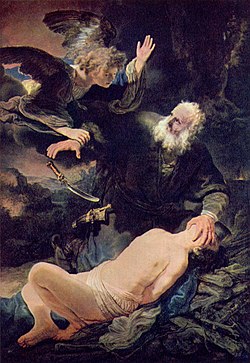
Abraham is the paragon of faith because he chose to believe in God's possibility over his own impossibility. God asked him to step into an unknown darkness on the basis only of His promise to make of him a great nation, numberless as the stars. To accomplish that through Isaac made sense; to sacrifice Isaac made none. Yet he followed when God said it was permitted to cast Ishmael, his other son, into the desert with his mother Hagar. After all, it was in his interest to do so, to extinguish claims to his inheritance by others than Sarah's firstborn, despite Hagar (and Ishmael) being his own (less faith filled) strategy of helping to accomplish God's promise of progeny. Could he now, in good conscience, and in light of God's continued promise, withhold his son Isaac from God's command?

To his eternal credit Abraham did not hold back, but stepped forward into the darkness of faith, believing in God's promise despite the impossibility of its being fulfilled in any way he humanly could imagine. (This based on Eleonore Stump's chapter on Abraham in Wandering in Darkness.)

As Giussani has observed in the Introduction to At the Threshold of the Christian Claim), Abraham took a step into the dizzyness of faith, the ultimate experience of our humanity. For only in faith can man enter into his greatest capacity: actively to surrender to God.

Listen to "Come to My Rescue" by Hillsong.

Listen to "At the Cross" by Hillsong.

Sunday, March 18, 2012

Blame or Beauty?

Today's gospel (4th Sun. Advent) shows Jesus healing a blind man, and incurring the enmity of the Pharisees for doing so. Our homilist offered an interesting comparison to explain the homily: Hercule Poirot and Vincent van Gogh. The former looks for the criminal -- like the disciples who asked Jesus, who is to blame for the blind man's condition -- and parses all things narrowly to get to the answer. Van Gogh looks at each thing to see it as it is, and paints it in its beauty and mundaneness. A chair, a room, a flower, a haystack, a pair of shoes . . . each is seen in its haeccity (as Hopkins and Scotus would term it), its beauty and uniqueness.

This, the homilist said, was how Jesus means to cure blindness. His "good news" is that this vision is possible, through eyes of love.

Listen to Don McClean's tribute to Vincent van Gogh, "Starry, Starry Night"

Listen to "Starry, Starry Night" by Chyi Yu.

Listen to "Through the Eyes of Love" by Regine Velasquez

Thursday, March 15, 2012

"I Remember . . ."

In an interesting article about science and religion, Rabbi Johnathan Sacks remarks that both modes of knowing are needed for a complete life, and so need to "work together." He boils his recent book The Great Partnership down to the following quote:
Science takes things apart to see how they work; religion puts things together to see what they mean.
Living with an appreciation of science and religion is living in stereo, he says. Without both we hear in monotone, and also miss the symphony of living. Religion is the "linking" agent that allows us to live life with meaning. Without it, life is without meaning, ultimately, because science does not seek meaning for persons, does not ask why.

The same idea appears in Chapter 8 of Benedict's Jesus of Nazareth, the reading assignment for this week's discussion group. The first part of the chapter is given to a discussion of controversies over the authenticity of John's gospel, many raised by so-called "scientific" approaches to bibilical interpretation. Some consider the Gospel of John to be a "Jesus poem," without historical authenticity. Benedict questions this, pointing out that the author(s) of the gospel pointedly brought out the remembered dimension of the facts they experienced. They could think back to an earlier comment of Jesus, which helped them understand a later event. They linked events in Jesus' life to their knowledge of the Torah and Jewish liturgical feasts.

In other words, they sought the meaning of what might otherwise be "banal facts" in their prior experiences with Jesus and in the collective experience of Jewish history and identity. In that light, the extraordinary story of Jesus' life, death and rising, was made meaningful. The authors of John's gospel captured this meaning, and offered it as an authentic witness to the crucial significance of Jesus' life, death and resurrection, for their community, and, of course, for us.

Benedict's point is that a "scientific" approach can get things oh, so wrong. This happened in the case of "scientific" biblical interpretation. The same can happen in our lives. We need a way to find meaning in the facts of our lives. Some do this with a diary or journal (blogging is another form). These activities of recording and remembering help to link the present to our remembered past and the significance it already has for us. So too with religion. Science can tell us "exterior" facts, and religion, as science's partner, can help us find our lives' "interior" meanings, the meanings that relate us to God, and in his love, to our fellow human beings.

So, blog away, and pray!

Listen to Jose Mari Chan sing "Life is a Constant Change"

Listen to Jose Mari Chan sing "Deep In My Heart"

Wednesday, March 14, 2012

Beautiful Friend

Yeats' Song of the Wandering Aengus is a paean to lost love. But I think of it as a meditation on love itself, its expectation and possible loss, but more so, its depth and dimensions. Love is at once (and always) one's muse and one's quest. As was the case in Yeats' life, it may be unrequited in the model sought. But its loss may have its most powerful and lasting presence and inspiration in helping us understand better love's depths and heights.

Love must always be appropriate to its object and relations. I cannot love my sister as a lover, nor claim another lover when I have a wife. These "rules" help love blossom in its many flowers and facets, bringing a joy appropriate to each experience of love.

The purest, most beautiful face of love is friendship, whose model is our love in God, and whose trace is in all loves. Philosopher Eleonore Stump says, "If a person takes God as her deepest heart's desire, all her other heart's desires [can be] woven into that deepest desire." Wandering in Darkness, p. 445. All of her loves can be nested in her love of and by God. All her loves become as gifts of God's love, enlightened, enriched, enjoyed, and returned, in God's love.

My prayer is that I may love all the loveable faces I see in the radiance of God's ever living, ever loving, love for me.

Listen to Donovan sing Yeats' poem.

Listen to Jose Mari Chan sing "Beautiful Girl."

Listen to Jose Mari Chan sing "A Love Song"

Listen to Jose Mari Chan sing, "Can We Just Stop and Talk a While?"

Listen to Jose Mari Chan sing "Tell Me Your Name"

I Will Be Careful With Your Heart

My wife Ellen turned . . . [a milestone in age] . . . last week. My kids came in from all corners of the country for a surprise party. My task was to make Ellen disappear from our home for the time it took all to assemble. And I came through! Ellen arrived home and was completely surprised, reacting with tears of joy.

I put together a video of our years together - 40 and counting -- an experience that made me realize how much I loved my wife when we first married . . . and that I can still love her with the feelings I had for her so many years ago. I recognized that true love is always young, and, in the words of Karen Carpenter, always "only just begun."

Love is a wonderful gift; may I not abuse it but return it unharmed and enhanced. The song by Jose Mari Chan, "Be Careful With My Heart" well describes the aspirations I have for our continued life together.


I must be doing something right, because she told me this morning, "I feel like a newly wed!"

Listen to Jose Mari Chan sing, "A Love to Last a Lifetime"

"Certum Est Quia Impossible Est"

It's hard to accept that "reality" could be something "impossible." The impossible is out of our control. Far better to keep things comfortably in our grasp.

But Tertullian said, I believe the Resurrection is certain, because it is impossible.

And Emily Dickinson wrote:

Impossibility, like wine
Exilarates the man
Who tastes it: possibility
Is flavorless.
Quoted in Eward Robinson, The Language of Mystery, p. 117.

God help us, if we only get what we want! Let us yearn for the impossible, and have courage to open our hands and let the dove we clutch fly free. For what is impossible for us is always possible for God. Luke 1:37 (angel Gabriel to Mary: "For nothing will be impossible for God." And as Jesus "kept saying" in the Garden of Gethsemani, "Abba (O Father), you hae the power to do all things. Take this cup away from me. But let it be as you would have it, not as I." Mk. 14:36.

Listen to Isao Tomita, "Clair de Lune"

Listen to Isao Tomita, "Jesu, Joy of Man's Desiring"

Listen to Isao Tomita, "When You Wish Upon a Star"

Listen to Isao Tomita, "Kosmos"

Listen to Isao Tomita, "Arabesque No.1"

Tuesday, March 13, 2012

Kneel to Be Real

Alexander Schmemann, in his For the Life of the World, defines secularism as "above all a negation of worship." (cited from David L. Schindler, Ordering Love, at p. 288.)

Schmemann believes that the "real," in truth, includes nature's relation to God, but that we have adopted (in modernity) a perspective that cuts it off from God. Why? Ultimately, to make matter amenable to our manipulation. But without a connection of matter with God, we, who are also matter, lose our own identity as creatures of God. Our own bodies become material fit for technology. We become something bodiless, and ultimately, unreal.

Schmemann invites us to a renewed sense of sacramentality:

We need water and oil, bread and wine in order to be in communion with God and to know Him. Yet conversely . . . it is this communion with God by means of 'matter' that reveals the true meaning of matter, i.e., of the world itself.
It is as sacramental that the world becomes real, has meaning. And, in seeing the sacramental nature of the world, we also become "real," we become who we are: homo adorans, the privileged being for whom a god, our God, is real.

To kneel is thus the proper human posture; it brings us to our reality, our elevated posture, in the nature of things.

Listen to Tantum Ergo Sacramentum.

Listen to Magnificat.

Listen to Charlie Daniels' "Kneel at the Cross"

Listen to John Michael Talbot, "Holy is His Name"