Thursday, September 17, 2015

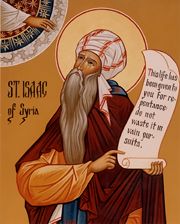
St. Isaac of Nineveh, Mystic


Here is another teaching of the mystic St. Isaac of Nineveh as paraphrased by Scott Cairns in his book of insights from the mystics in verse form, Endless Life. What follows provides some aspects of hell that you may not have considered.

Gehenna, Its Duration

Even in the matter of afflictions

-          The judgement of Gehenna, say –

there abides a hidden mystery, whereby

            the Maker has taken as a starting point

our patent willfulness, using even Hell

            as a way of bringing to perfection

His greater dispensation.


If the world to come proves entirely the realm

            of mercy, love, and goodness,

how then a final state that claims 

            requital for its measure?


That we should think that hell

            is not also full

of love and mingled with compassion

            would be an insult to our God.

By saying He will deliver us

            to suffering without purpose, we

most surely sin. We blaspheme also if we say

            that He will act with spite or with a vengeful purpose,

as if  He had a need to avenge Himself. 

Saturday, August 22, 2015

What's Love Got to do With It


In discussions and announcements of the latest gay rights, an often repeated phrase is that now we have the right to love who we want to love. This is just an attempt to attach an emotional string to an issue that is currently front and center in order to cater to the specious desires of a those who wish to reduce love to merely its sexual component. The fact is that for a long time people have had the right to love whomever they want.

Philosophers and theologians have generally recognized four type of love storge, philio, eros and agapeC. S. Lewis in his book Four Loves describes them.

Storge refers to a love or affection toward a family member such as love between parents and their children.
Philo is an affection between friends.
Eros is romantic love and agape is a spiritual love.

The exercise of any of these forms of love does not and should not need any civil authority to permit their practice. For very understandable reasons society has, however, placed taboos and restrictions on the way these loves are expressed. Many of these restrictions and taboos center on the sexual aspects of love. Might I suggest that it is these taboos that this phrase is referring to. Each of the forms of love has at one time or another had a sexual component attached to it. Each culture, society or community has placed certain permissions and restrictions on the sexual behavior allowed in each of these forms of love.

Currently, both familial affections and close friendships are considered not to include sexual intercourse. Cultural mores establish the accepted behavior in each of these forms of love. Incest is not acceptable, friends engaging in sexual intercourse are recognized as having moved to an erotic relationship. Agape, as spiritual, is concerned with complete self-giving and so is free of the reciprocity characteristic of erotic love. None of these three forms of love require permission from civil authority to allow one to engage in them.

Neither does erotic love. In its more elevated characteristics it needs no civil permissions in order to be exercised. Mutual self-giving, a single-minded regard for the other and its solemn privilege to procreate, educate and so carry on the advancement of the human condition, these are all aspects of erotic love that need no civil authority to validate or affirm them.

So what then has society been given by finally allowing someone to love who they want to love? In such a statement love is reduced to merely its sexual component, completely divorcing sex from its higher giftedness. Reducing love to mere self-gratification. Really, what’s love got to do with it?


Reading the Mystics


I am sure many other Christians have had the same urge as I have had. The urge, after some brief glimpse of the work of a mystic, a desire to read more. So we procure a book or treatise by the mystic only to find much of their writings dense and incomprehensible.
In May I ran across a poem by author-poet Scott Cairns a Professor at the University of Missouri. The poem was in an anthology, Francis and Clare in poetry. (See post of May 9) I found the poem to be quite moving and so sought out more of Professor Cairns work. I obtained a copy of his book Endless Life poems of the mystics and discovered in it the answer to approaching the mystics with understanding and an appreciation of the beauty of their thoughts. He has taken the prose writings of thirty seven mystics and rendered into verse a sampling of their reflections. Professor Cairn’s poetic style is easy and beautiful and transmits the musings of the mystics in very readable verse. Check it out. I offer a sample of his poetry based on the writings of St. Melito of Sardis.


How It Was
The earth trembled; its foundations
shook like silt; the sun, chagrined,
fled the scene, and every mundane
element scattered in retreat. The day
became the night: for light could not endure
the image of the Master hanging on a tree.
All creation was astonished, perplexed
and stammering, What new mystery is this?
The Judge is judged, and yet He holds His peace;
the Invisible One is utterly exposed, and yet
is not ashamed; the Incomprehensible is grasped,
and will not turn indignant; the Immensity
is circumscribed, and acquiesces; the absolutely
Unattainable suffers, and yet does not avenge;
the Immortal dies, and utters not a word;
the Celestial is pressed into the earthen grave,
and He endures! What new mystery is this?
The whole creation, I say, was astonished;
but, when our Lord stood up in Hades –
trampling death underfoot, subduing
the strong one, setting every captive free –
then all creation saw clearly that for its sake
the Judge was condemned, et cetera.
For our Lord, even when He deigned
to be born, was condemned in order
that He might show mercy, was bound
that He might loose, was seized
that He might release, suffered
that He might show compassion, died
that He might give life, was laid in the grave
that He might rise, might raise.
Sunday, August 16, 2015

Heart-to-Heart Chatter

At the heart of Christianity is taking Christ to heart.  That means encountering Christ as a real presence, a real human being in my life.  I can't have a personal relationship with Christ as a concept, an idea, and ideal.  How do I move to encounter Christ as God, but also as a human person?

If Augustine's Confessions can be taken as an example, the first step -- a step that took many years for Augustine -- is conversion.  The first 8 books of the Confessions detail that journey.  Then comes the rest of life, which, according to Augustine, involves being Christ's servant and companion.  Augustine had a colorful expression for this phase as he closed the first chapter of Book 9.  He said, "and I used to chatter to you." (et garriebam tibi).

That strikes me as a genuine mark of personal encounter. Chattering away shows familiarity in my relationship with another person, and that the relationship is alive and well.  Of course, chattering away with God, as Augustine did, is another word for prayer.

Lord, help me to be garrulous with you, to chatter away with you, even while I listen for your answering word.


Thursday, July 23, 2015

The Exercise of Freedom

For those of us who live in democratic societies where we find ourselves able to express our beliefs in relative safety, our freedom allows us together with others of like mind to demonstrate those beliefs. Following is a portion of and opinion piece published in the Boston Pilot by Fr. Jose Medina. Go to the link FATHER JOSÉ MEDINA for the entire text.


In the wake of the recent Supreme Court ruling on same-sex marriages, in which we gather more signs of a society repudiating an orthodox Christian mindset, we call into question how we stand before a turning tide. How do we react now, in the forthcoming legislation, and in this challenging climate? ...
...The power of the Christian announcement is something capable of renewing man and allowing him to rediscover a fullness of life, independent of favorable or adverse circumstances. 
...  The legalization of same sex marriage by the Supreme Court shouldn't be misunderstood as a call to action in defense of Christian values, but a call to conversion, a call to rediscover the method by which Christ conquers the human heart and carries the historically proven capacity to build civilizations.
The Christian proposal has neither lost its appeal or its capacity to deliver fullness of life. ...
The legalization of same-sex marriage by the Supreme Court should not provoke the militant defense of Christian values. We are not called to bolster the remnants of a society that was once rooted in the Christian experience, but to live it again, and in time, rebuild. Telling people what values to espouse is neither lovable, nor effective. Instead, we are called to live and share a fullness of life openly with everyone, within any circumstance -- whether they are welcoming or not. For this reason, a call to conversion is not a retreat from a hostile environment. In fact, it implies quite the opposite. While some would deem the public witnesses of our brothers and sisters ineffective or naÏve, this is the function of the Church in human history: to continuously testify that the fullness of life can only be achieved in total dependence on the Mystery. After all, as Christians we are not called to defend the Truth as a set of values, but to incarnate it.
Father José Medina has devoted much of his professional career to the world of education first as teacher of Math and Science and as Principal in Washington DC and Boston. He is a native of Spain and a member of the Priestly Fraternity of the Missionaries of St. Charles Borromeo. He received his civil engineering degree from the Universidad Politécnica de Madrid, a Bachelors of Sacred Theology from the Pontificia Università Lateranense in Rome, Italy and a Master in Education from the Harvard Graduate School of Education. Currently, Father Medina is the national leader of the Catholic ecclesial movement Communion and Liberation.
 Reprinted from the Boston Pilot, Tuesday, July 07, 2015

Thursday, July 16, 2015

Freedom - Where Art Thou?

“What kind of world are we going to be living in?” A question posed by a college student to her father, a good friend. The question is indicative of a deep seated longing held for millenia. The longing is a desire to live out of deeply held beliefs, not just in the privacy of our own lives, but in a community of like believers; believers with the same social and moral values we personally hold. A community of believers that can provide support and affirmation and strength when the beliefs we hold are tested and we need the strength to hold firm to them.

There was a time when the world was small and societies developed in isolation from other cultures and their commonly held beliefs and ways of living were able to function and flourish and support the people who lived in them. Their fellow citizens supported them in their endeavor to live with integrity. But, the earth grew larger and societies began an intersection and interaction with each other. In this interaction conflict was brought on by differing, deeply held beliefs and values. Old Testament history is replete with stories of the Hebrew people and their attempt to live the ways of their God while intermingling with foreign peoples.  
Modern societies have grown and widely divergent cultures overlap. We can see in modern day nationalism a desire for countries to hold firm to their identities, identities that are composed of the deeply held beliefs and mores of their culture. Yet, our modern governments, especially the United States, strive to eliminate the differences between peoples of variously formed cultural identities. The ideal has become a homogeneous society in which cultural differences are discouraged and eliminated. People can no longer establish and nurture a community in which one can find support and affirmation in their beliefs and the free exercise of their values. Such communities, when adhering to values that are not widely accepted, find themselves belittled and labeled as bigoted and intolerant.

I hope I have not given an impression that I have suggestions to offer that would remedy this dilemma. The tendency for modern democracies to strive for equality in all things for all is gradually pulling communities apart. The desire people have to live with like-minded others in communities that are supportive of values held in common is gradually being denied. Here in the United States the founders thought that the system of a confederation of states, each with its own way of life, bound together by a few fundamental beliefs was the perfect answer. Yet, the homogenization of our culture by a Federal authority is relentlessly in progress; all for the sake of freedom to live the way such authority deems we should live.

Sunday, June 21, 2015

Freedom and Responsibility

 Amidst the discussion and controversy surrounding government assistance to the poor and the "free" benefits that all citizens should receive, one has a hard time discerning how a Christian should respond. On one hand we feel duped by those who take advantage of governmental benefits and on the other hand we feel compassion for those who really need it. We feel compelled to help and at the same time angry at a system that allows mass abuses; a system that discourages personal initiative and encourages a victim mentality that places responsibility for our economic deficiencies at the feet of someone else.

With much more clarity and depth Michael Novak speaks to these issues in an article in the June-July issue of First Things. The article is entitled "The Future of Democratic Capitalism". You can go to the First Things website for the complete article. Here is some of what he says:

 "Notwithstanding what happens in China, the sad fact is that almost everywhere in the world today, systems properly called capitalist and democratic are facing grave difficulties. It cannot be supposed that human beings always love liberty. Free persons must meet the burdens of personal responsibility, and for some, that responsibility is too onerous. If I may paraphrase Dostoevsky: “When people cry out for liberty, give it to them—in fifteen minutes they will give it back.” For most of history, humans have been remarkably un-rebellious under tyranny. If their simplest appetites are met, why should they take up irksome responsibilities?
So it is today. Not all human beings desire to be economically free. If they are free, they are obligated to bear responsibility for their own welfare. Of course, there is always some percentage of the population too old or too young, too ill or too disabled, to carry their own weight in economic responsibility. There will always be some people who rightly depend upon the help of others. By its own moral identity, any honest Jewish, Christian, or even secular humanist society must come to their aid.
Yet, as John Paul II pointed out in Centesimus Annus, there are huge drawbacks in entrusting such welfare exclusively to the administrative state. Such a state is a highly flawed instrument for helping the poor. For one thing, it tends to treat them (indeed, by legal requirements of equal protection,must treat them) as interchangeable units of the citizenry, and too often this means impersonally. That is, the state must treat them as clients rather than as full-fledged, responsible persons with their own unique backgrounds, needs, and aspirations.
Some do not trust private efforts, private businesses, corporations, or even individuals and civic associations to bring sufficient care to the able-bodied poor. Instead, they prefer to trust government to do so, even if only by borrowing money, for which task they pledge the obligations of their children and their grandchildren. Such persons may be models of compassion, but their generosity is dubious when they do not resolve to pay for their own moral actions."