Wednesday, March 9, 2022

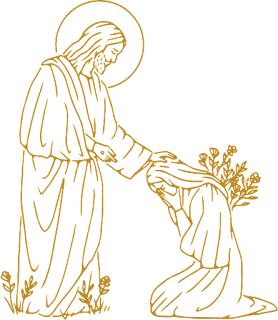
The Shepherd left the rest and came to earth to find her ... he found her, he did not lead her, but carried her back!


From the previous post:

“ …we cannot deny his providence towards the rest of his creatures; but the Bride claims his attention for herself.”

St. Bernard continues:

3. It is obvious that what the Apostle says about oxen[1] has no reference to the Bride; he who loves her and gave himself for her[2] must needs care for her.[3] Is she not that lost sheep[4] whose care came before even that of the heavenly flock?[5] The Shepherd left the rest and came to earth to find her. He sought her diligently, and when he found her[6]he did not lead her, but carried her back! Then on her account he called the angels together and celebrated a new and joyful festival with her. How then can it be said that he will not care for her,[7]when he deigned to carry her on his shoulders? She is not mistaken,[8]then, when she says, 'The Lord takes thought for me',[9]nor is she deceived when she says, 'The Lord will fulfill his purpose for me'[10] or when she says anything else which shows God's love for her. Thus it is she speaks of the Lord of Hosts as her beloved, and glories[11] that he who judges all things in tranquility[12]cares for her. Why should she not glory? She has heard him sing to her, ’Can a woman forget her child, and not have compassion on him? And even if she does forget him, yet I will not forget you.'[13] Again, 'The eyes of the Lord are upon the righteous.'[14] Now what is the bride but the congregation of the righteous? What is she but the generation of those who seek the face of the Bridegroom?[15] It cannot be that he should incline to her, and she not inclined to him. Therefore she says, 'He inclines to me and I to him. He inclines to me because he is good and gracious;[16] I incline to him because I am not ungrateful. He gives me grace from his graciousness;[17] I give him gratitude for grace. He has a care for my deliverance and my salvation; I for his honor and the fulfillment of his will. He has a care for me, and for no other, for I am his only dove;[18] I have a care for him and for no other;[19] do not hear the voice of others, nor do I listen to those who say "Look, here is Christ" or "look, here he is!"[20] It is the Church who speaks.

CISTERCIAN FATHERS SERIES: NUMBER FORTY - BERNARD OF CLAIRVAUX – ON THE SONG OF SONGS IV - Sermon 68.3


[1] 1 Cor 9:9  [2] Gal 1:4  [3] Lk 10:35  [4] Mt 18:12  [5] 1 Pet2:23  [6] Lk 15:5  [7] Lk 10:35  

[8] Heb 2:11  [9] Ps 40:18  [10] Ps 138:8  [11] Wis 12:18  [12] 1 Cor 2:15  [13] Is 49:15  

[14]  Ps 34:16  [15] Ps 24:6  [16] Jl 2:13  [17] Jn 1:16  [18] Sg 6:8  [19] Jn 10:15     [20] Mk13:21


Tuesday, March 8, 2022

“My lover belongs to me and I to him; he feeds among the lilies.”


“My lover belongs to me and I to him; he feeds among the lilies.” Sg 2:16 NRSV

“I belong to my lover; his yearning is for me.” Sg 7:11 NRSV


 With these verses in mind St. Benedict expounds on who is the Bridegroom and who the Bride.

“1. …. The Bride has spoken, and has said that the Bridegroom inclines himself to her; Sg 2:17, Sg 7:11 who then is the Bride, and who is the Bridegroom? The Bridegroom is our God, Ps 48:15 and we, I say in all humility, are the Bride – we, and the whole multitude of captives whom he acknowledges. Let us rejoice that this glory is ours; 2 Cor 1:12we are they to whom God inclines. But how unequal a partnership! What are the earth-born, the children of men, Ps 49:3 in his presence? In the words of the Prophet Isaiah, 'they are as if they were not, they're considered by him as nothing but emptiness.' Is 40:17 What meaning can there be in a comparison between such different persons? Either the Bride glorifies herself beyond measure, or the Bridegroom loves beyond measure. How wonderful that she should claim as her own the attention of the Bridegroom when she says, 'my beloved is mine', Sg 2:16 nor is she yet content, but goes on to glorify herself even more, by replying to him in her turn as to an equal; for she continues, 'and I am his'. A wonderful saying – 'and I am his'; and no less wonderful, 'My Beloved is mine'. Sg 2:16  But that both should be said together – that is more wonderful than either.

2. There is nothing that a pure heart, a good conscience, and an unfeigned faith will not venture. 1 Tim 1:5 'He inclines to me', says the Bride. Does this great Majesty incline to her thus – this Majesty on whom rests the government and administration of the universe? Does the care of the world give way to the business – or rather the repose – of the love and desire of the Bride? Yes indeed, for she is the church the elect, of whom the Apostle Paul says, 'I endure everything for the sake of the elect'. 2 Tim 2:10 And who can doubt that God shows grace and mercy to his saints, Wis 4:15 and is mindful of his elect. Therefore we cannot deny his providence towards the rest of his creatures; but the Bride claims his attention for herself. Is it for oxen that God is concerned? 1 Cor 9:9 No doubt we can say the same about horses, camels, elephants, and all the beasts on Earth and fishes of the sea and the birds of the air;    Gen 1:26 indeed of everything on the earth accept only those to whom it is said, 'Casting all your care upon him for he cares for you.' 1 Pet 5:7 Do you not see that this is the same as saying, 'Incline to him, for he inclines to you'? And notice that the Apostle Peter, whose words these are, preserves the same order of words as does the Bride, for he says, 'casting all your care upon him' – not 'in order that he may care for you' but 'because he cares for you,' Ps 89:6 thereby revealing not only the depth of his love for the Church of the Saints, but also its eternal quality."

CISTERCIAN FATHERS SERIES: NUMBER FORTY - BERNARD OF CLAIRVAUX – ON THE SONG OF SONGS IV, Sermon 68.1-3

Thursday, March 3, 2022

Word Craft

 I am a long time subscriber and for the past decade, at least, the recipient of an annual gift subscription to First Things, published by the Institute on Religion and Public Life. In the March issue I noticed the writing of Patricia Snow.

It is especially gratifying to find an author whose wordcraft concisely expresses what the author intends to convey. So, when I encounter an author who displays that talent I take notice. An example is the following quote from an article by Richard Neuhaus, First Things founding editor. The article speaks to the writings of Hans Urs von Balthasar.

“He went in for heavy-duty intellection that is sometimes ponderous and exhaustingly discursive, but always adorned with dazzling erudition and rewarding one's effort with scintillating insights of a frequently counterintuitive nature.” April 2006 issue of First Things

Patricia Snow’s essay relates an experience she had at her church, St. Mary’s in New Haven Connecticut. It is the church where she attended RCIA sessions. In her essay she describes St. Mary’s Church during one of the daily Masses she attended.

“… in St. Mary’s a soft natural light was continually in play, washing sequentially through the saturated membranes of the windows. Furthermore, everything was painted in St. Mary’s, saving the pews and the floor. The walls in those days were a drab yellow and the high pentagonal apse behind the altar was an English red, which in turn was figured over, like wallpaper, with a shimmering, gold-leaf pattern of fleur-de-lis. The tall pillars in the nave were the color of algae and the vaulted roof overhead was an azure canopy, fastened up with powder-blue filaments and gold medallions. Add to this the polychrome statues of saints – statues that, like the windows, were brought down within reach – and intricately painted and gilded bas-relief Stations of the Cross, and the colorful exuberance of the whole sounds almost too much on paper, yet it worked in the church, in the dim recesses around the altar especially, where the reds that were almost orange and the greens that were almost blue were at once resplendent and fugitive, overstating and vanishing, like the iridescent plumage of a tropical bird.” First Things, On The Threshhold, March 2022

" dazzling erudition" and “scintillating insights of a frequently counterintuitive nature”

“where the reds that were almost orange and the greens that were almost blue were at once resplendent and fugitive”

Neuhaus made me want to seek out in Balthasar those “scintillating insights”. Snow’s description of St. Mary’s Church makes me want to visit St. Mary’s to see those colors that “were at once resplendent and fugitive, overstating and vanishing”; fugitive colors, what inspiration!

Sunday, February 27, 2022

Catch us the little foxes that spoil the vines, for our vines are in flower.” Sg 2:15

St. Bernard - El Greco

 God came as a man in order to redeem his people. Declared in Scripture, even by a Roman soldier, it is what makes Christianity so difficult for humanity to believe. It is a fact preached upon many times by the disciples and fathers of the Church. In Sermon 64 on the Song of Songs St. Bernard lends his eloquence to the message.

“Catch us the little foxes that spoil the vines, for our vines are in flower.” Sg 2:15

Focusing on the word “us” in this verse St. Bernard takes us on a flight of theological reflection.

“He who has deigned to unite himself with us does not look upon our advantage as something foreign to himself, for he orders the foxes to be caught, not for himself, but for us along with him. Notice that he says 'for us'. What gracious condescension! Do you not think that he is speaking as the father of the family, in that he keeps nothing for himself, but has everything in common with his wife and children and household? He who speaks is indeed God, yet it is not as God that he speaks, but as a Bridegroom.

'Catch us the foxes.' You see how he speaks, as though to equals – he who has no equal. He could've said 'me', but he preferred to say 'us', for he delights in companionship. What sweetness! What grace! What a mighty love! Can it be that the Highest of all is made one with all? Who has brought this about? Love has brought this about, without regard for its own dignity, strong in affection and efficacious in persuasion. What could be more violent? Love prevails even with God. What could be so nonviolent? It is love. What force is there, I ask, which advances so violently towards victory, yet is so unresisting to violence? For he emptied himself, so that you might know that it was the fullness of love which was out- poured Phil 2: 7, that his loftiness was laid low and that his unique nature made to be your fellow. With whom, O wonderful Bridegroom, have you such familiar friendship? 'Catch them for us,' he says. For whom, besides you? For the Church of the Gentiles? She is made up of mortals and sinners. What she is, we know; but who are you Jn 1:19, so devoted to the ethiopian Num 12:1 woman, so eager a lover? … Are you not he who is the fairest of the children of men? Ps 44:3, Wis 7:26 I have said too little. You are the brightness of eternal life, the splendor and image of the being of God, God over all, blessed forever. Heb 1:3, Rom 9:5 Amen."  from Sermon 64.9-10

CISTERCIAN FATHERS SERIES: NUMBER THIRTY-ONE - BERNARD OF CLAIRVAUX – ON THE SONG OF SONGS III

Thursday, February 10, 2022

On the Passing of Our Son

To my friends and family, it is with much regret that we report that our son Robert Jr. has been called home to his maker. Bob was our first child and our first attempt at perfecting the parenting skills we inherited from our parents. No one can doubt what extreme pain and sorrow is experienced by a parent at such a loss. Yet, we are people of faith.

“Now faith is the assurance of things hoped for, the conviction of things not seen.” It is in these words that those of us of faith find our consolation. St. Bernard of Clairvaux in a sermon on the Song of Songs expresses his convictions and his hopes on the death of his brother and fellow monk, Gerard. His sentiments echo mine and I am sure those of many of our friends and family as well.

I paraphrase and adapt his thoughts: Bob possessed a body that is both frail and burdensome and, freed from the body, he may fly to the embraces of Christ. Why has he been torn from us? We loved each other in life how can it be that death separates us? What a harvest of joys, what a profusion of blessing is yours Bob. You have the abiding presence of Christ. All that smacks of weakness you have cast away but not what pertains to love. And since love never comes to an end, you will not forget us forever. One can scarcely speak of him as dead! Was he not rather transplanted into life? By his death it is we who died not he, he has but gone to sleep in the Lord.

I have no wish to repudiate the decrees of God… Shall I find fault with his judgment because I wince from the pain? It is but human and necessary that we respond to our friends with feeling: that we be happy in their company, disappointed in their absence.… The reluctance to part and the yearning for each other when separated, indicate how meaningful their mutual love must be when they are together. We grieve for you Bob not for the sake of grieving, but because you have been separated from us… We experience the sufferings that are shared equally by lovers when compelled to remain apart.

… our weeping is not a sign of a lack of faith, it indicates the human condition. You hear the heavy note of sorrow in my words…. My song, O Lord, shall be of mercy and judgment. Let that mercy poured out by you on your servant Bob sing to you… I praise your goodness to him. You are righteous indeed, O Lord… You gave us Bob, you took him away and if his removal makes me sad I do not forget that he was given to us and offer thanks for our good fortune in having had him… What more shall I say? You entrusted Bob to us, you have claimed him back; you have but taken what was yours. Our tears prevent speaking further; impose a limit on them O Lord, bring them to an end. 

Thursday, January 27, 2022

Of the Fig Tree and of the Vines


Continuing from the post of January 20:

“5. Perhaps a Jew will complain that I have gone to access in insulting him…. But let him read Isaiah and he will hear something even less flattering: 'The ox knows its owner, and the ass it's master’s crib; but Israel does not know me, my people does not understand.' (Is 1:3) … Yet the prophet did not speak here in his own person but in that of God, who proclaims by his very works that he is God: 'even though you do not believe me’, he said, ‘believe the works.'; ‘and if I am not doing the works of my Father, then do not believe me.' (Jn 10:38) Even this did not wake them up to understanding. Neither the expulsion of devils nor the obedience of the elements nor the raising of the dead could banish from them this… stupidity. Out of this blindness no less monstrous than miserable they rushed into that horrifying and incredibly crude crime of laying sacrilegious hands on the majestic Lord. From that moment it could be said that the fig tree had put forth its green figs, for the institutions of the Jewish law were drawing to a close, so that, in accord with the old prophecy, as the new was coming on the old would be cleared away. (Lev 26:10)”

Now St. Bernard turns his attention to the phrase in Song 2:13 that mentions the vines.

Song 2:13 – “The fig tree puts forth its figs and the vines are in blossom; they give forth fragrance. Arise, my love, my fair one and come away.”

“II.6. … The vines in flower yield their sweet perfume … this perfume drives away snakes. They say that when vines are flowering every poisonous reptile leaves the place …. I want our novices to take note of this … reflecting on the spirit they have received, whose first fruits the devils cannot tolerate. If initial fervor can achieve this what will finished perfection do? … ‘The vines in flower yield their sweet perfume.’ This is how it was in the beginning: a new life ensued from the preaching, new grace for those who believed; (Rom 6:4) they lived virtuously among the pagans (1 Pet 2:12) and bore the good perfume of Christ (2 Cor 2:15) wherever they went. Good perfume means good witness. It comes from right behavior as perfume comes from the flower. And since in the early days of the infant church faithful souls, like so many spiritual vines, seemed laden with this kind of flower and perfume, being well thought of even by outsiders, (1 Tim 3:7) I think it not unfitting to apply this phrase to them. To what end? That those who had not believed might find it a challenge, and reflecting on the believer’s upright conduct, would themselves glorify God, (1 Pet 2:12) and thus for them the perfume of life would lead to life. (2 Cor 2:16)”  

One of the challenges of Sermon 60 was that St. Bernard seems to have not completed the metaphor of the fig tree before going off on another line of thought. Perhaps he recognized this and so in section III.9 he ties these two metaphors together. He must have felt the same confusion I experienced when I attempted to condense this sermon to its essential points.

“III.9 … I say then that by the grace of God which is in us (Rom 12:3) we have both fig trees and vines in our midst. The fig trees are the gentle in character, the vines those aglow with the spirit. (Rom 12:11) Anyone who lives among us in harmony with the community, who not only mingles with his brothers without complaining, but with a very friendly attitude even makes himself available to all for any occasion of loving service, (Phil 2:15) why should I not very fittingly speak of him as a fig tree? If he first sprouts his green figs it is necessary that he shed them, for instance the fear of judgment that is driven out by perfect love, (1 Jn 4:18) and the bitterness of sinning which is sure to yield to sincere confession, the infusion of grace and an abundant outpouring of tears. There are other similar things too that like green figs precede sweet fruit, things you can reflect on by yourselves.”

From section III.10:

“Now those who are vines reveal themselves to us as more austere than amiable, they take action in an eager frame of mind, they are zealous for discipline, rigorous in correcting abuses, and thus aptly make their own the psalmist’s words: ‘Do I not hate those who hate you, O Lord, and loathe those who defy you?’ (Ps 139:21) and, ‘zeal for your house devours me.’ (Ps 69:10) The one [those like the fig tree] seems to me to excel in love of neighbor the other [those like the vines] in love of God.”

Regardless of this sense I feel of an insufficiently developed metaphor, Sermon 60 leaves the reader with a prayer worth remembering.

“But let us pause here under this vine and this fig tree (1 Kgs 4:25)* in the shade of God’s love and our neighbor’s. Both loves are mine when I love you, Lord Jesus, my neighbor because you are a man and showed mercy to me (Lk 10:36-37), and nevertheless you are God over all, blessed forever. Amen. (Rom 9:5)”

*The Vulgate contains the following verse which does not appear in chapter four of the NRSV translation of the Bible “And Juda, and Israel, dwelt without any fear, every one under his vine, and under his fig tree, from Dan to Bersabee, all the days of Solomon.” The NRSV ends chapter four of 1 Kings with verse 19. The Vulgate contains verses up to number 34.


Thursday, January 20, 2022

The fig tree has put forth its green figs. (Song of Songs 2:13)


“The fig tree has put forth its green figs.” (Sg. 2:13) With this quote St. Bernard opens Sermon 60 on the Song of Songs. Now the fig tree has a peculiar reproductive process. There is an initial bud called a breba producing a crop relatively early in the year on the previous year's growth. These fruits are frequently small, acidic and inferior in texture. The second crop occurs later in the year on the current year's growth and these figs are edible. The fig tree does not flower; its flowers, male and female, are inside the fruit, enclosed by the outer shell and so never displays a flower before budding.

This process becomes the seed for a theological reflection critical of the nation of Israel before the coming of Christ.

“I do not think myself free to apply this passage to people in general, however: one person is distinctly referred to. For he did not speak of many trees …, but of one … meaning I think, the Jewish people. How often the Saviour uses this image in the Gospel! [Lk 13:6; Lk 21:29; Jn 1:48; Mk 11:13-14] … The fig tree is a good image, for though sprouting from the sound patriarchal root it never aimed to reach for the sky, never aimed at lifting itself from the ground, never responded to the root by putting out branches, by blooming to flower, by an abundance of fruit. O stunted twisted, knotty tree, how completely ill suited to you is your root. For the root is holy. (Rom 11:16) Does any thing worthy of it appear in your branches? .… Worthless seed, you have not brought these forth from that noble root. What it contains is of the Holy Spirit (Mt 1:20) and in every respect refined and sweet. Where then do these green figs come from? And really what does that nation have that is not crude? Neither their actions nor their inclinations nor their understanding; not even the rites with which they worship God. Their actions are summed up in strife, their whole orientation was to wealth, their understanding was darkened in literalism, they worshipped with the blood of sheep and cattle.”

CISTERCIAN FATHERS SERIES: NUMBER THIRTY-ONE - BERNARD OF CLAIRVAUX – ON THE SONG OF SONGS III

Lest you begin to feel that St. Bernard is too hard on the Jewish people a reading of Matthew 23:29-36, in fact all of Mt 23, you will see Jesus equally critical and even condemnatory of his chosen people.

More on the fig tree as a symbol of the Jewish people in the next post.